Where the standards cover measuring equipment
For testing and calibration laboratories, ISO/IEC 17025 is the benchmark. The requirements for equipment are mainly found in clause 6.4 (equipment) and 6.5 (metrological traceability). Companies with a quality management system under ISO 9001 find comparable requirements in clause 7.1.5 (monitoring and measuring resources).
Neither standard prescribes a particular software. Both, however, require every instrument to be uniquely identified, calibrated as planned, traceable and fully documented. That is exactly the job of test equipment management, whether as a system of its own or as a module of a LIMS.
Calibration programme and calibration intervals
Equipment whose measurement accuracy or measurement uncertainty affects the validity of results must be calibrated. ISO/IEC 17025 requires a calibration programme for this, which is reviewed and adjusted as necessary.
In practice, it is defined for every instrument whether and at which interval it is calibrated, internally or externally. Due dates must be visible in good time so that no instrument with an expired calibration is used. Where needed, intermediate checks maintain confidence in the measurement between two calibrations.
Metrological traceability
Measurement results must be traceable to the International System of Units (SI) through an unbroken chain of calibrations. This is usually achieved through calibration by an accredited calibration laboratory or in your own lab with traceable reference standards.
The calibration certificate is the evidence: service provider, date, results, measurement uncertainty and certificate number belong to every calibration and must be quick to find.
Labelling and defective equipment
Equipment that requires calibration is labelled so that its calibration status or period of validity can be seen, for example with a label showing the next due date.
If an instrument has been overloaded, mishandled or gives questionable results, it is taken out of service and labelled until it has been shown to work correctly again. In addition, you check whether earlier results are affected. A risk assessment records which measurements may be affected and what consequences the deviation has.
Which records are needed for each instrument
ISO/IEC 17025 lists minimum information to be retained for every relevant piece of equipment. In summary:
- Identity of the equipment, including software and firmware version
- Manufacturer, type and serial number or another unique identification
- Evidence that the equipment conforms with specified requirements
- Current location
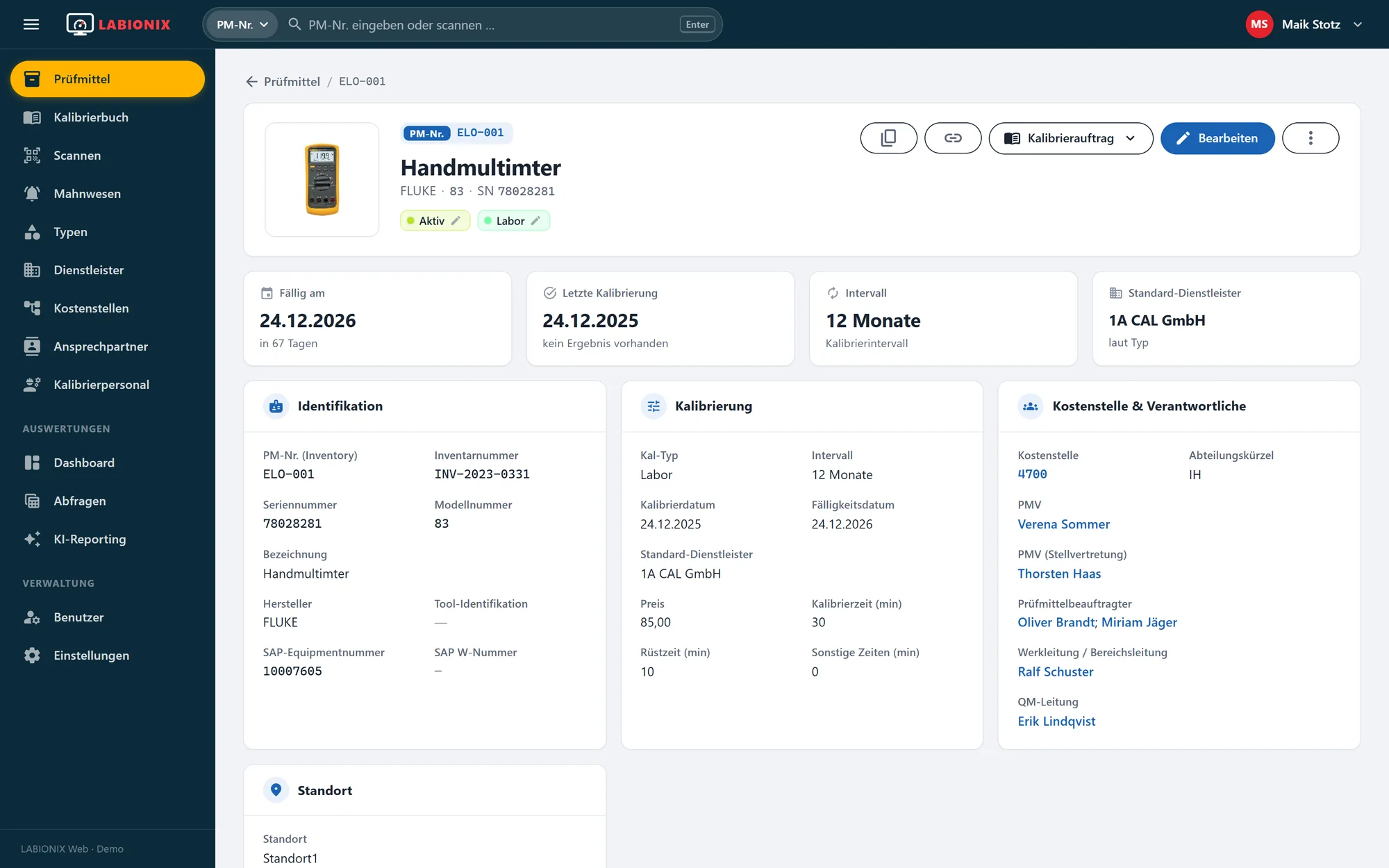
- Calibration dates, results, adjustments, acceptance criteria and the next due date or interval
- Documentation of reference materials with results and validity
- Maintenance plan and maintenance carried out, where relevant to performance
- Damage, malfunction, modification and repair
If you keep this information together in one equipment record, it is ready for the audit in minutes rather than hours.
Checklist for your next audit
- Every instrument has a unique number and a label showing its calibration status.
- Calibration intervals are defined and justified.
- Overdue instruments are blocked or out of service.
- There is a calibration certificate with certificate number for every calibration.
- Deviations are assessed and affected results reviewed.
- Changes to equipment data can be traced with date, user and reason.
- Due-date lists per site or cost centre can be produced at any time.
How LABIONIX helps
LABIONIX keeps a record for every instrument with master data, location, status, documents and complete history. Due dates appear on the dashboard and in due-date lists, and the reminder module notifies the responsible people by e-mail. QR labels make every instrument easy to find by scanning.
Calibration certificates, certificate numbers and measurement results are attached to the calibration job, and a failed calibration produces the risk assessment report. Revisions are saved with a reason. If you still use MET/TEAM® today, you will find everything about switching on the page MET/TEAM® end of life: your move to LABIONIX.
This article summarises the requirements in our own words and does not replace the text of the standard. LABIONIX supports you in meeting the requirements; implementation within your quality management remains your responsibility.
